Service / Field brief
Write Service Levels for Internal Work
Internal service levels work best when they define a complete request, a meaningful outcome, and the conditions that can change the clock.
Internal work often depends on informal promises. A team says it usually responds in two days, but “respond” can mean an acknowledgment, a question, or a completed result. The requesting team plans around one meaning while the service team reports another. Both can be acting in good faith and still create repeated conflict.
A useful service level defines the work in a way that both sides can observe. It is not only a target number. It describes the request, the clock, the outcome, the priority rules, and the responsibilities of the requester and provider.
Define a complete request
The service team should list the minimum information needed to begin. Keep the list short and connected to decisions. A required field that no one uses creates effort without improving the result.
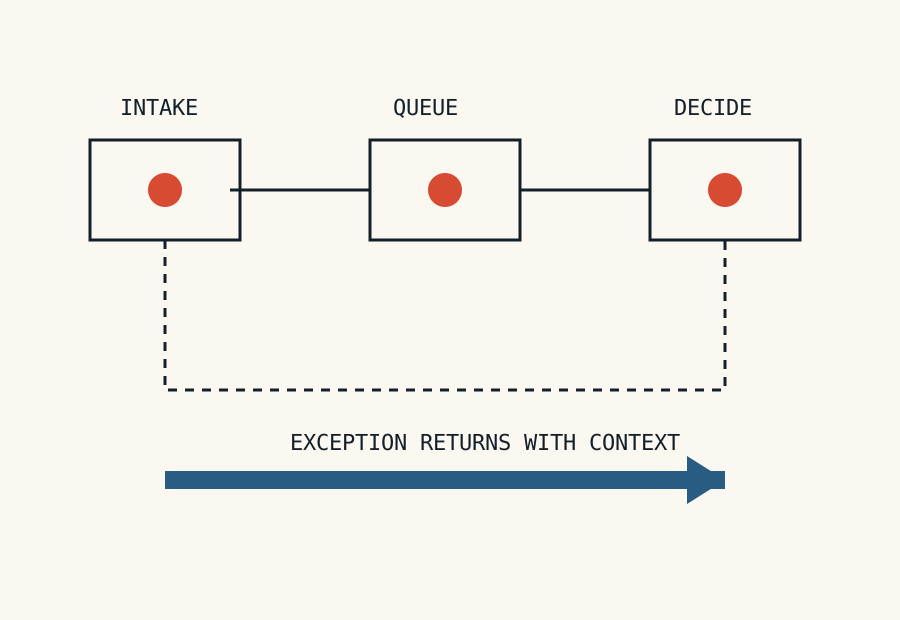
When a request is incomplete, return it with a specific explanation. Do not place it in an invisible holding state. Record when the request arrived, when the missing information was identified, and when the completed request returned. This allows the teams to see both service delay and input problems.
The form should not force a requester to diagnose the service team’s internal structure. Ask about the desired outcome and relevant facts. Let routing logic select the correct queue.
Choose the correct clock
Some work needs a time to first meaningful response. Other work needs a time to resolution. Many services need both. An automated acknowledgment is not a meaningful response unless it gives the requester useful information about the next step.
State whether the target uses calendar time, business days, or staffed hours. State the time zone and holiday rules. If the clock can pause, define the pause conditions and keep the gross elapsed time available for review.
Define priority by consequence
Priority should reflect impact and time sensitivity. It should not depend only on the requester’s title or use of urgent language. Create a few clear classes with examples. Require a reason for the highest class and allow the service team to correct misclassification with an explanation.
An urgent class needs a corresponding operating response. If every queue and staffing model remains the same, the label has little value. Define who is alerted, which work can move, and how the decision is recorded.
State the outcome
Completion should mean that the requester received a result they can use: access granted, analysis delivered, issue resolved, or a final reason for denial. An internal task closure is not enough when another hidden step remains.
For complex work, use milestones. A legal review can have intake confirmation, issue identification, draft advice, and final advice. Each milestone should communicate what is known and what remains rather than create more status labels.
Include both sides of the promise
The service provider promises a response and outcome under stated conditions. The requester promises accurate information, timely answers, and an available decision owner. This does not divide blame. It makes dependencies visible.
Document escalation for both missed service targets and blocked requester actions. The escalation should go to a role that can change priority, capacity, or policy. Sending more reminders to the same queue is not escalation.
Review the promise with evidence
Measure elapsed time, target attainment, exceptions, rework, and requester effort. A high attainment rate can be misleading if the target is so loose that it does not support the business need. A low rate can reflect demand growth, poor inputs, or a target that never matched capacity.
Review the agreement on a fixed schedule and after material service changes. Do not change the definition silently to improve the metric. Keep the prior definition and effective date so trends remain understandable.
A service level succeeds when it reduces uncertainty. Requesters know what to provide and when to expect a usable result. The service team knows what it has promised, which work comes first, and when leaders must make a capacity or policy decision.